AI for Science · Scientific machine learning
Physics-Informed Inversion of PROSAIL for Earth Observation
Retrieving vegetation biophysical variables from Sentinel-2 imagery by inverting the PROSAIL radiative transfer model with neural networks that use the physical model as a differentiable decoder, trained only on simulated data.
- Role
- AI Research Engineer Fellow, InstaDeep (Nov 2024 – May 2025) · Co-author of the preprint
- Status
- Preprint — arXiv:2511.10387
- Earth observation
- Sentinel-2
- PROSAIL
- Radiative transfer
- Physics-informed ML
- Self-supervised learning
- Variational inference
Overview
During my Young African AI Research Fellowship at InstaDeep, on the InstaGeo team’s AI for Social Good work, I worked on scientific machine learning for Earth observation: estimating the biophysical state of vegetation from satellite reflectance. The variables of interest are leaf area index (LAI), canopy chlorophyll content (CCC) and canopy water content (CWC), which underpin crop monitoring, carbon accounting and ecosystem models. The work led to a preprint, co-developed with Prince Mensah, Ibrahim Salihu Yusuf and Arnu Pretorius, proposing a physics-informed Transformer-VAE for inverting the PROSAIL radiative transfer model on Sentinel-2 imagery.
Scientific problem
PROSAIL couples a leaf optical model (PROSPECT) with a canopy reflectance model (SAIL). Given leaf and canopy parameters it simulates the reflectance a satellite would observe. The scientific task is the inverse problem: recover those parameters from observed Sentinel-2 spectra. The inversion is ill-posed, because different parameter combinations can produce nearly identical spectra, and in-situ measurements for supervised training are scarce and expensive. Operational tools such as the Sentinel-2 biophysical processor in SNAP train neural networks on PROSAIL simulations but return point estimates without a principled account of uncertainty.
Methodology
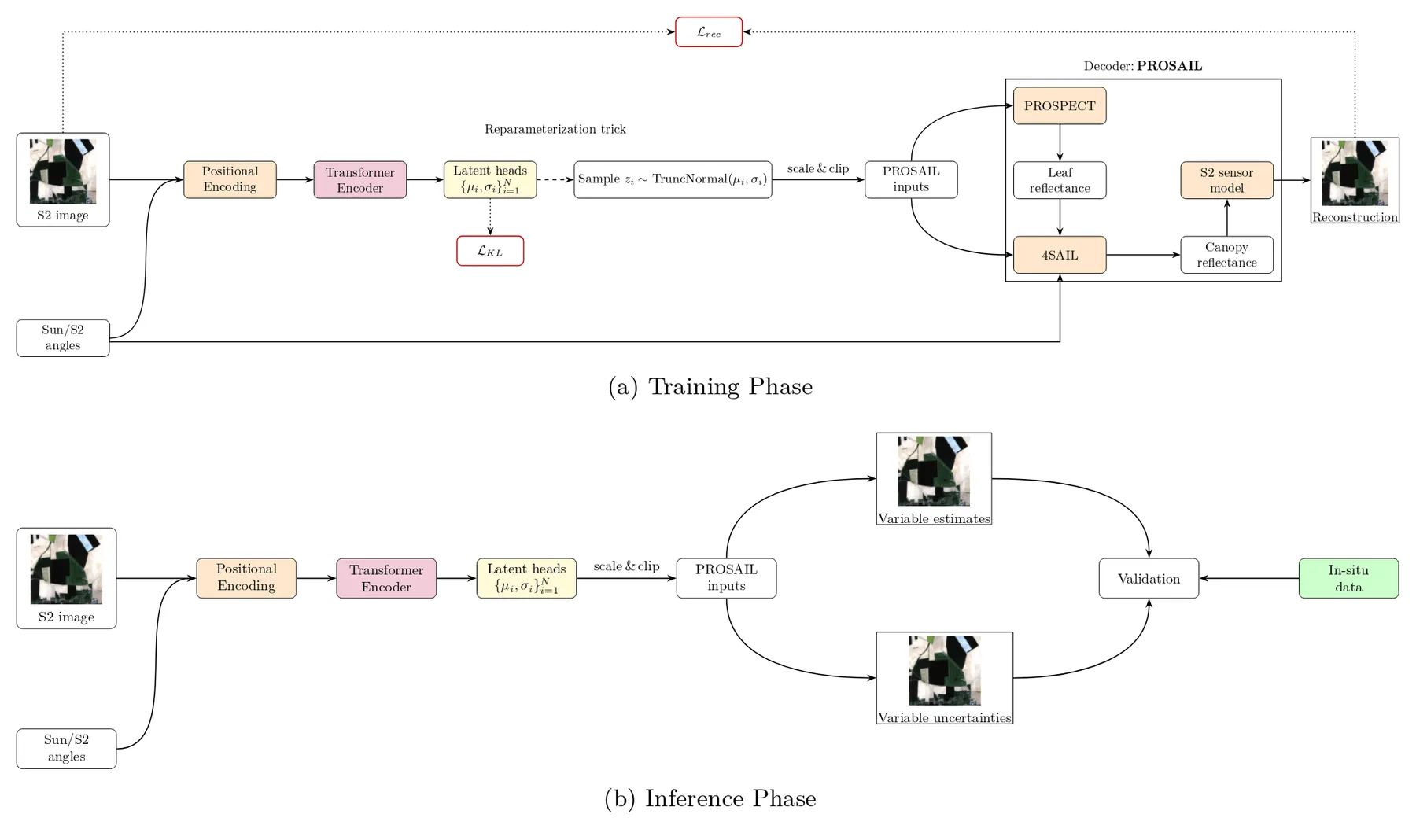
- Physics in the loop. PROSAIL is implemented in PyTorch as a fixed, differentiable decoder with no trainable weights. A neural encoder predicts the biophysical parameters; the decoder pushes them through the physics to reconstruct the observed spectrum, and the reconstruction error trains the encoder. Training is fully self-supervised on simulated data, so no real images or field labels are needed.
- Fellowship contributions. I developed the self-supervised framework that integrates PyTorch PROSAIL to train a ResNet-MLP for LAI, CCC and CWC retrieval; reduced memory overhead by 60% through chunk-based data generation with batch sizes of 5k–10k samples; implemented parameter bounding with scaled sigmoid transforms so that sampled parameters never produce physically invalid reflectance; and validated the models against Sentinel-2 in-situ measurements of LAI and CCC.
- Transformer-VAE. The preprint extends this to a variational formulation: a Transformer encoder maps a Sentinel-2 spectrum (with acquisition geometry) to truncated-normal distributions over the PROSAIL parameters, giving a posterior rather than a single value, trained on 500,000 simulated samples.
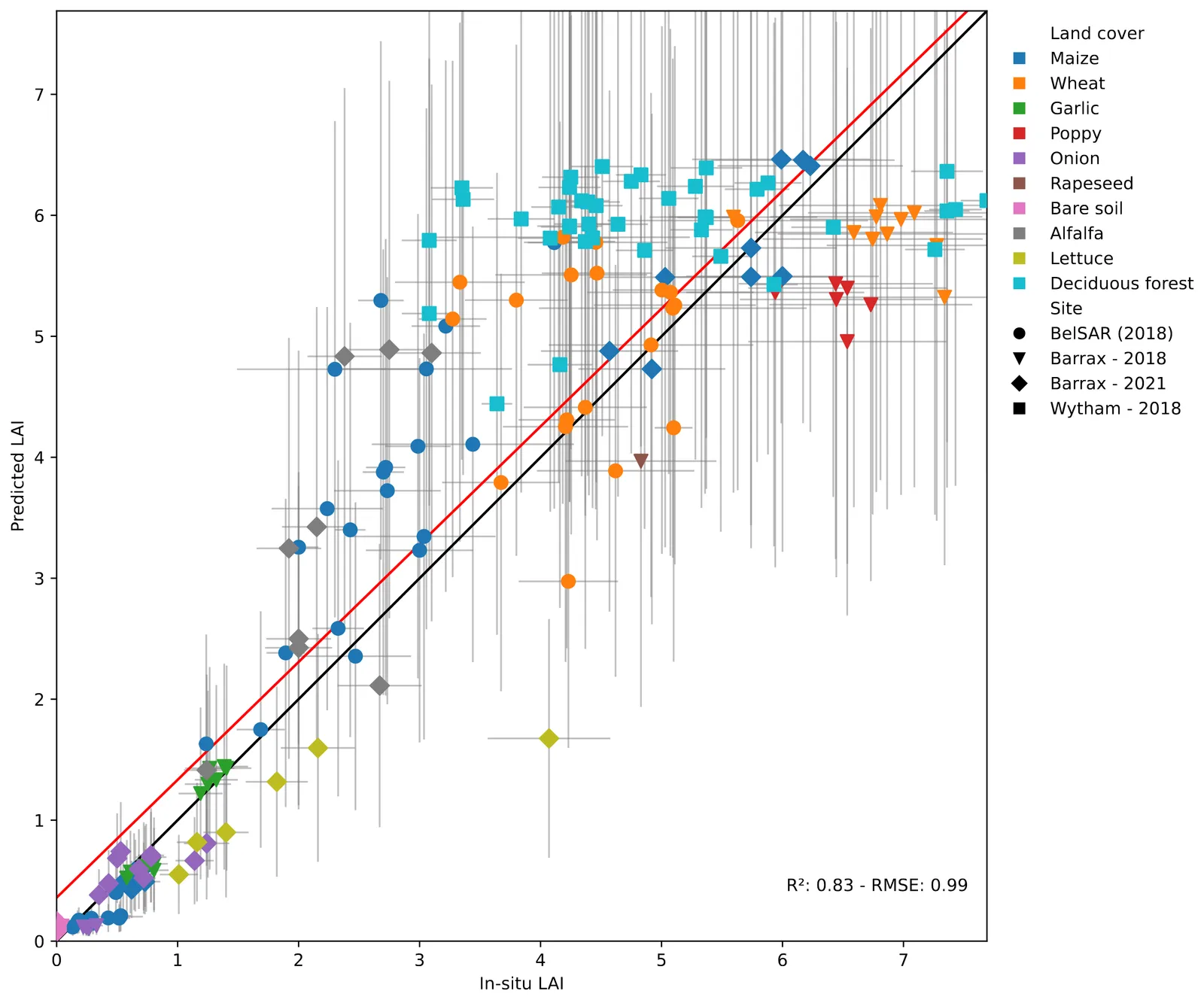
- Validation. Retrieved LAI and CCC are compared with in-situ reference measurements from the FRM4Veg campaigns (Barrax crop sites in Spain and Wytham Woods forest in England) and the BelSAR campaign in Belgium, against the SNAP processor and a prior PROSAIL-VAE baseline.
Results (as reported in the preprint)
| Variable | Transformer-VAE | SNAP processor | PROSAIL-VAE |
|---|---|---|---|
| LAI, all sites (RMSE / R²) | 0.99 / 0.83 | 1.24 / 0.71 | 1.16 / 0.75 |
| CCC, FRM4Veg (RMSE) | 76.56 | 88.08 | 42.33 |
For LAI the method outperforms both baselines despite never seeing a real image during training, and its prediction intervals reach 95% coverage overall. Canopy chlorophyll content remains harder: the model improves on SNAP but not on the PROSAIL-VAE baseline, which the preprint discusses openly as a direction for further work.
Why it matters
This work is where my interest in structured and interpretable machine learning took shape. Keeping the physics in the loop makes the latent variables physically meaningful, gives calibrated uncertainty, and lets the model generalise from simulation to real satellite data. The same principle, learning with a known forward model as an inductive bias, carries over to medical imaging and other scientific domains.
Related publication
2025
Physics informed Transformer-VAE for biophysical parameter estimation: PROSAIL model inversion in Sentinel-2 imagery
Prince Mensah, Pelumi Victor Aderinto, Ibrahim Salihu Yusuf, Arnu Pretorius
arXiv preprint arXiv:2511.10387
BibTeX
@misc{mensah2025physicsinformedtransformervaebiophysical,
  title         = {Physics informed Transformer-VAE for biophysical parameter estimation: PROSAIL model inversion in Sentinel-2 imagery},
  author        = {Prince Mensah and Pelumi Victor Aderinto and Ibrahim Salihu Yusuf and Arnu Pretorius},
  year          = {2025},
  eprint        = {2511.10387},
  archivePrefix = {arXiv},
  primaryClass  = {cs.CV},
  url           = {https://arxiv.org/abs/2511.10387}
}