Generative AI · Reasoning in complex systems
The LLM as a Network Operator
A vision for embedding large language models in the 6G radio access network control loop, with a formal framework aligned to the O-RAN architecture and results on policy expressiveness and convergence.
- Role
- Co-author · Workshop paper, NeurIPS 2025 AI4NextG
- Status
- Poster — AI4NextG Workshop @ NeurIPS 2025
- Large language models
- 6G
- O-RAN
- Intent-based control
- Reasoning
Overview
This paper, co-authored with Oluwaseyi Giwa, Michael Adewole and Tobi Awodumila, was presented as a poster at the NeurIPS 2025 Workshop on AI and ML for Next-Generation Wireless Communications and Networking (AI4NextG) in San Diego. It asks what role generative models should play in operating next-generation communication networks, where control decisions must satisfy both human intent and strict physical and timing constraints.
Research problem
Radio access networks are managed through layers of controllers operating at different timescales. Operators express goals in natural language (“prioritise emergency-service traffic in this region”), but the network acts through low-level configuration. Bridging that gap today requires substantial manual engineering. Large language models can interpret intent and reason over context, but it is not obvious how to place them in a real-time control loop without compromising stability, safety or latency.
Methodology and contributions
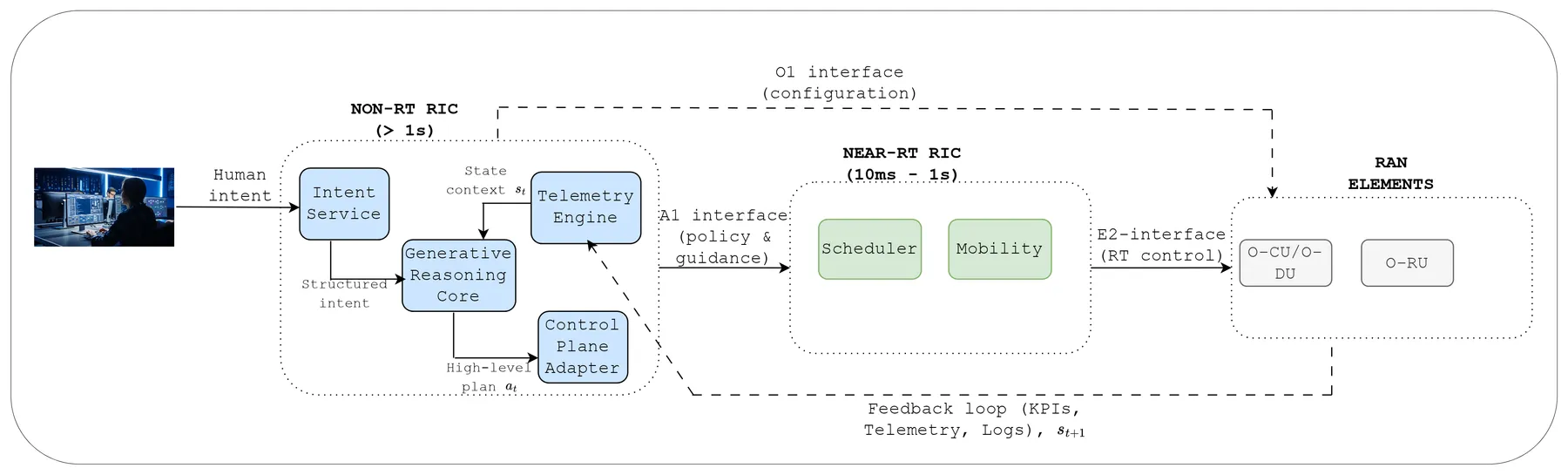
- The LLM-RAN operator. The paper proposes an architecture in which an LLM translates high-level intents into network actions, acting as a strategic layer rather than a millisecond-scale controller. An Intent Service and a Reasoning Core reside in the Non-Real-Time RAN Intelligent Controller (RIC) and generate policies for a Control Adapter, which configures applications in the Near-Real-Time RIC.
- O-RAN alignment. The design separates slower, strategic guidance produced by the LLM from fast, reactive execution, connected through an adapter that follows the O-RAN interfaces.
- Formal framework. The contribution is primarily conceptual and theoretical: a proposition on the expressiveness of the policies the LLM layer can represent, and a theorem on convergence of the resulting control loop to stable fixed points.
- Open challenges. The paper identifies safety, real-time performance and grounding in the physical world as the central research questions for making the vision practical.
Why it matters
For me this work is a case study in reasoning and representation: using a generative model as a reasoning component inside a larger system with its own dynamics, and being explicit about the guarantees such a component can and cannot provide. The same questions recur in my engineering work on real-time multimodal and embodied systems.
Related publication
2025
The LLM as a Network Operator: A Vision for Generative AI in the 6G Radio Access Network
Oluwaseyi Giwa, Michael Adewole, Tobi Awodumila, Pelumi Aderinto
NeurIPS 2025 Workshop on AI and ML for Next-Generation Wireless Communications and Networking (AI4NextG), San Diego, USA.
Poster at AI4NextG @ NeurIPS 2025, San Diego, December 2025
BibTeX
@misc{giwa2025llmnetworkoperatorvision,
  title         = {The LLM as a Network Operator: A Vision for Generative AI in the 6G Radio Access Network},
  author        = {Oluwaseyi Giwa and Michael Adewole and Tobi Awodumila and Pelumi Aderinto},
  year          = {2025},
  eprint        = {2509.10478},
  archivePrefix = {arXiv},
  primaryClass  = {cs.NI},
  url           = {https://arxiv.org/abs/2509.10478},
  note          = {NeurIPS 2025 Workshop on AI and ML for Next-Generation Wireless Communications and Networking (AI4NextG)}
}